Showing posts with label olympic hiking trails. Show all posts

Friday, July 1, 2011

Walkin' in the Woods


It is obvious that I like to hike. Although hiking has been the topic in only two of my forty-six posts, it has been a topic in fifteen more.

Exactly one year ago I wrote about four walks to waterfalls in a particular area of North Carolina. In selecting them, my only criteria were “that they be easy enough for a family with kids to complete” and “that the drive from town to trailhead not take more than several minutes.”

Today I have decided to write another post about family-friendly hikes, but without confining myself to one area and without requiring that the trails be close to town. So here, in alphabetical order, are four of my favorite easy hikes in America -- and it is pure coincidence that once again, waterfalls are seen on all of them:


Abrams Falls Trail, Tennessee

At 2.2 miles one-way and 4.4 round-trip, this is the longest walk I will mention here, and if your kids are younger than seven or eight you might end up carrying them part of the way. The trailhead is located approximately five miles onto the Cades Cove Loop Road in Great Smoky Mountains National Park, and the trail parallels the course of Abrams Creek while following a series of modest undulations up to a low ridge. After attaining the ridge, it switches back and descends the other side to where the waterfall awaits.

Abrams Falls is only 20 feet tall, yet it carries an enormous amount of water that makes it more striking than some falls that are much taller. And that water plunges into a deep pool that is one of the best swimming holes in the mountains, so if you make this hike on a hot summer day, feel free to jump in and cool off. While you’re at it, keep an eye out for otters swimming in the stream and playing on the banks. Just be sure not to walk on the rocks, which are very slippery and have led to many injuries over the years.


Lewis Falls Trail, Wyoming

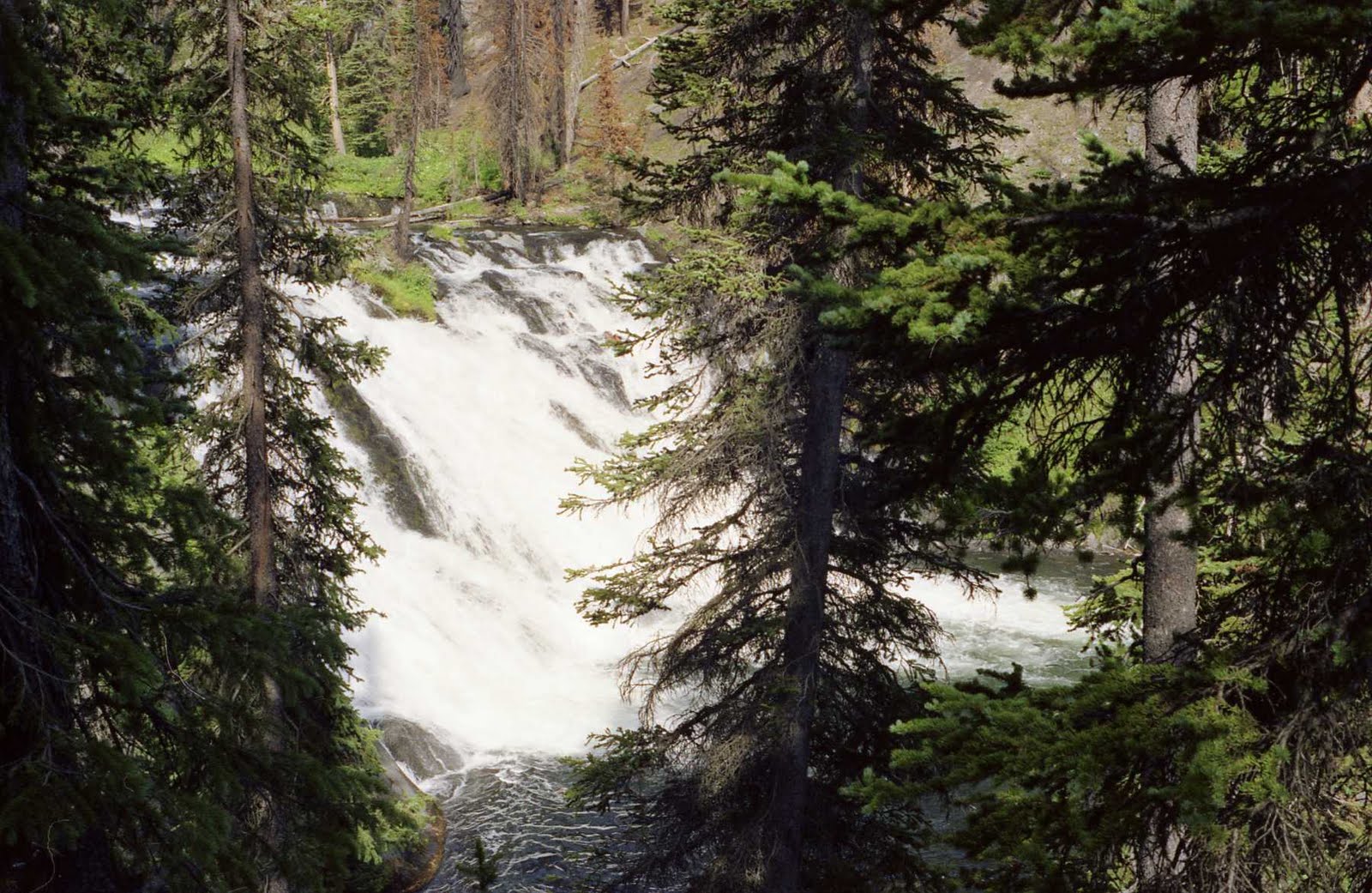
Ten miles after driving into Yellowstone National Park through its southern entrance, you will cross a bridge over the Lewis River, from which Lewis Falls is visible upstream. Turn off the road after crossing the bridge and you will find that the beginning of the wide, well-trodden path to the falls is obvious. This is another waterfall that impresses because of its sheer water volume rather than its height; and it is also impressive because of its 60-foot width and because some of the trees around it still show signs of the fires that raged through Yellowstone 23 summers ago. The walk is ridiculously short (less than a tenth of a mile) and provides a perfect example of how a simple change in perspective can make a big difference in the way an object appears: The first picture below was taken at the beginning of the walk, while the second was taken near its end.


Pfeiffer Falls and Valley View Trails, California

In California’s Coastal Range is Pfeiffer Big Sur State Park, where these two trails combine to form a 2½-mile loop. Start on the Pfeiffer Falls Trail (PFT) and do not take the left hand turn onto the Valley View Trail (VVT) that you see early on. The PFT ascends through a redwood forest while following the course of a gently cascading creek. After seven-tenths of a mile it ends at Pfeiffer Falls, from which you will backtrack a short distance and then take the right fork to the VVT, crossing a pair of bridges in short order.

Take the next right turn you come to and follow it to the VVT’s northern terminus where the trail offers up this view of the Big Sur Valley. From here, turn around and remain on the VVT until it ends by emptying onto the PFT back at that junction you skipped at the beginning. By the end of this hike’s 2½ miles you will have experienced an elevation change of 450 feet -- big enough to count, small enough for the whole family to complete.


Rainy Lake Trail, Washington

This trail is remarkable in that it takes you to a high-altitude alpine lake in one of the most rugged and remote corners of America, but is easy enough that it can be completed even by the wheelchair-bound. The one-mile haul to the lake departs from a high point on the south shoulder of the North Cascades Highway; remains almost perfectly level the whole way; and on top of that, is paved. Once you reach the lake you will see that it is a sight to behold, surrounded by snowy, chiseled ridges and fed by ribbon-like waterfalls flowing down the slopes on the opposite side. Fishing is allowed. The trail is within Ross Lake National Recreation Area, which bisects North Cascades National Park, and its trailside signs are very informative. If you want to see a better shot of the view I photographed below, go here.


Tuesday, May 18, 2010

Northwestward Hoh


My last post was about Port Angeles, Washington, a town that receives only 25 inches of annual precipitation despite being located on the famously wet Olympic Peninsula. I wrote that spending time in Port Angeles could make it “hard to believe you are sharing the peninsula with temperate rain forests.”

But trust me when I say you won’t have to travel far to find those soggy woods. As the crow flies, less than 60 miles away is a valley where annual rainfall exceeds 12 feet and fog drip adds another 2½ feet to that. It is a place where branches are clothed in green moss, trees stand taller than 20-story buildings, and ferns grow larger than men. This is the Hoh Rain Forest, and here is a picture of Erika and me at the base of one of its giant Sitka spruces, looking frighteningly young:


Located farther north than Toronto, the Hoh disproves the common belief that all rain forests are tropical jungles. Its abundance of established trees makes it hard for young ones to gain a foothold on the forest floor, but this problem is solved by nurse logs. Basically, after a log falls it starts to decay very slowly, and in the process becomes a kind of compost. When seeds from other trees land on that log, they germinate and grow from it rather than from the ground; and as they age their roots extend not only through the log but around it. Eventually the log decays entirely and vanishes, and any tree that “nursed” on it is left perched on above-ground roots.


Animal lovers will enjoy the Hoh just as much as plant lovers. Its most celebrated species is the Roosevelt elk, which outweighs the Rocky Mountain elk by 25 percent and lives only on the Olympic Peninsula. Meanwhile, cougars prowl the forest and spotted owls nest in the canopy. Black bears feed on fish from the Hoh River, which include chinook salmon, coho salmon, and steelhead trout. And, not to be outdone, banana slugs attract attention with their 9-inch length and bright yellow color.

The routing of roads around the perimeter of Olympic National Park means you must travel farther than a crow to get from Port Angeles to the Hoh. However, the drive’s scenery more than makes up for its 1½-hour duration, and Twilight fans will be happy to know it goes right through Forks and past the turn-off to La Push.

Once you arrive you will have ample opportunity to experience the rain forest up close, since three hiking trails depart from the vicinity of the visitor center. They are the ¾–mile Hall of Mosses Trail, 1¼-mile Spruce Trail, and 17-mile Hoh River Trail. We completed the first two and hiked part of the third. This picture shows where one of them was routed between fallen logs:


Plan on spending at least one night in the wild if you want to hike the third trail in its entirety, because its 17 miles are one-way. From it, you can connect with the Hoh Lake Trail and make your way up the slopes of the peninsula’s highest mountain, all the way above timberline to the edge of Blue Glacier.

No matter how much you already “love nature,” after you see the Hoh Rain Forest you will have an even greater appreciation of just how prolific our world is.